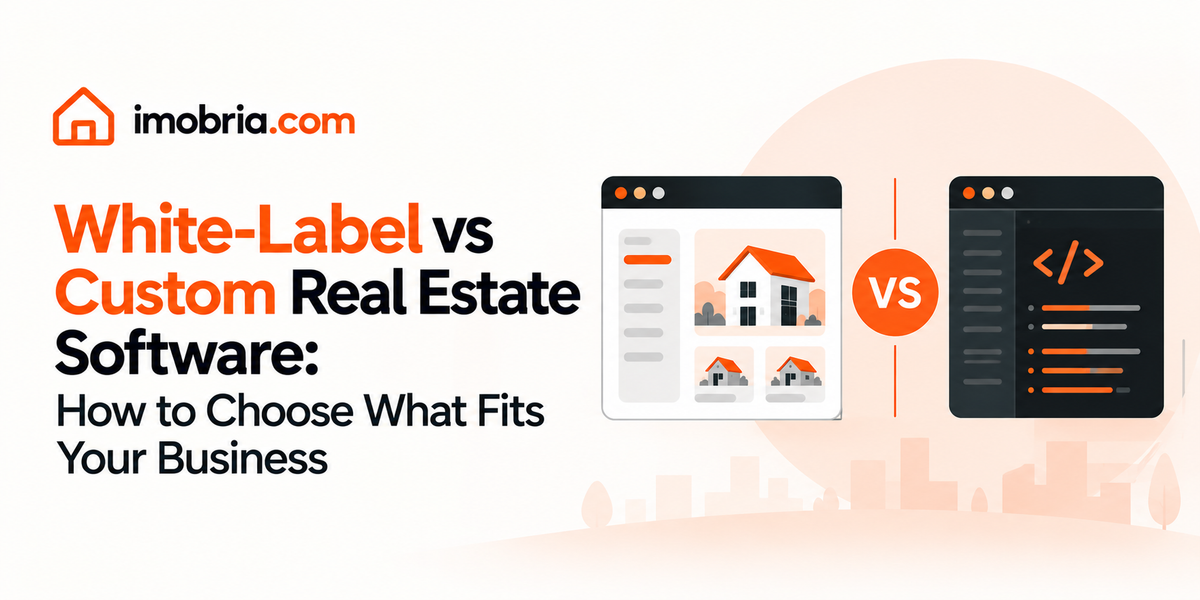
The choice between white-label vs custom real estate software comes down to how much you need to control and how fast you need to launch. A white-label platform gives you a complete, rebranded marketplace in weeks for a predictable subscription. A custom build gives you full ownership of the code and total freedom over features, at a far higher cost and a timeline of months or years. Most agencies, brokerages and developers are better served by white-label unless they have a genuinely unusual requirement.
What is white-label real estate software?
White-label software is a finished product you rebrand and run as your own. Your logo, your colours, your domain. End users never see the vendor's name.
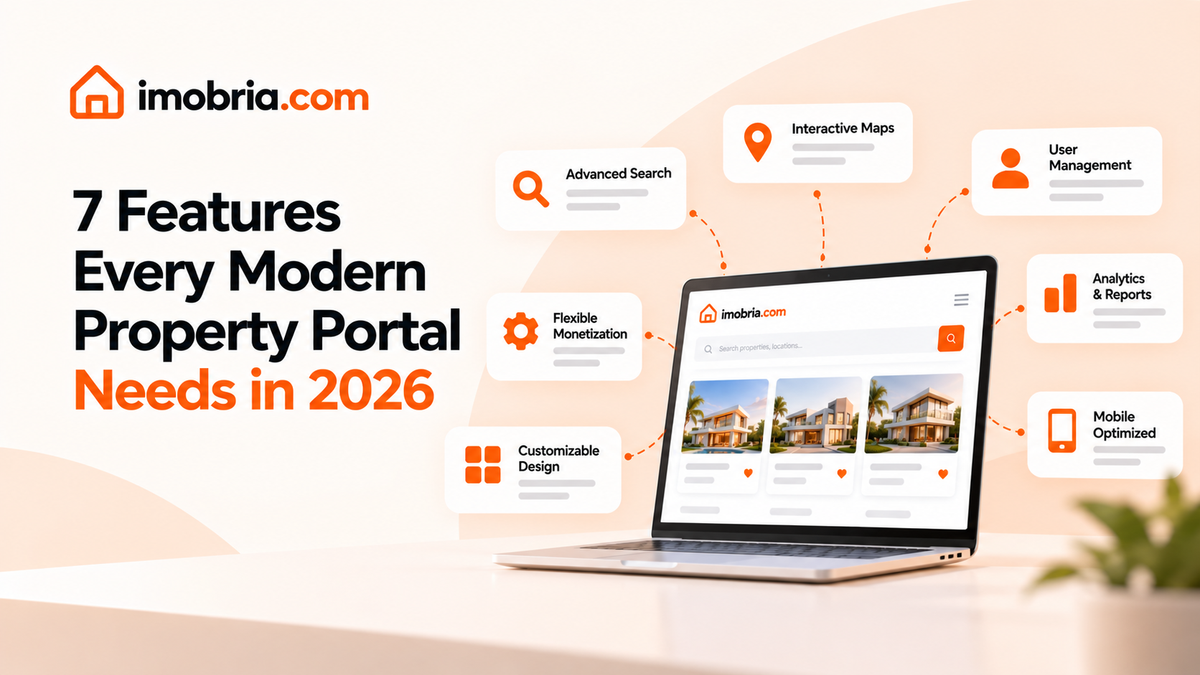
With Imobria, that means a full property marketplace covering buy, rent, new developments and commercial listings, plus off-plan and auction formats. The platform ships with AI-powered search, map and polygon (draw-on-map) search, listing and lead management, a built-in CRM, agent and agency profiles with verified reviews, a viewing scheduler, portal syndication to Rightmove, Zillow, Idealista and more, integrated payments, analytics, and multi-language and multi-currency support. You configure it, brand it and sell it. Hosting, security, scaling, GDPR compliance and updates sit with the vendor.
When does a custom build make sense?
A custom build is the right call when your business model genuinely cannot be expressed inside an existing product. That might be a novel transaction type, a proprietary valuation engine, or a tight integration with internal systems no portal supports out of the box.
The trade-off is real. Building a comparable platform from scratch typically runs well into six figures and takes roughly 12 to 18 months before you have something live. Then you carry ongoing maintenance, often around 15 to 20% of the build cost every year, to keep pace with security patches, portal API changes and feature expectations. You own the asset, and every problem that comes with it.
How do the two approaches compare on cost and speed?
The gap is wide enough to decide most cases on its own.
- Speed: White-label launches in around three weeks. A custom build runs 12 to 18 months before go-live.
- Upfront cost: White-label is a subscription with no large capital outlay. Custom is a six-figure commitment before you earn a penny.
- Maintenance: With white-label, updates and fixes are included. With custom, maintenance is your recurring cost.
- Risk: White-label is proven across many clients. Custom carries the full risk of a bespoke project, including overruns and scope creep.
For most businesses, the question is whether a few bespoke features are worth a year of delay and a six-figure bill.
Does white-label mean I give up control?
Less than people assume. A mature white-label product gives you control over the things that affect your business: branding, pricing, listing rules, user roles, languages, currencies and multi-branch or franchise structures.
Imobria includes role-based permissions and multi-branch support, so a franchise network can run many offices under one system with the right access at each level. You shape how the marketplace works for your market, without maintaining the plumbing underneath it.
What if I need something the platform does not do?
This is where the decision stops being binary. With Imobria you are not choosing between a rigid template and a full custom build. The standard platform covers the vast majority of what a property business needs, and Cod3Labs, the company behind Imobria, provides bespoke development for anything beyond it.
That means you can launch fast on the proven platform, prove the model, and commission custom work only for the features that set you apart. You avoid paying six figures to rebuild things that already exist, and still get the bespoke capability where it matters.
How do I decide which one fits?
Start with three questions. How quickly do you need to be live? How much capital will you risk before the product earns revenue? And is your core requirement genuinely unique, or does it just feel that way?
If you need to move quickly, protect your cash and run a recognisable property business model, white-label is almost always the stronger choice. More than 50 organisations across 40-plus countries run on Imobria, handling over 100,000 listings between them. If your requirement is truly singular and central to your business, a custom or hybrid build is worth the investment.
Frequently asked questions
What is the main difference between white-label and custom real estate software?
White-label is a finished platform you rebrand and launch quickly for a subscription, with maintenance included. Custom software is built from scratch to your exact specification, giving you full ownership at a much higher cost and a far longer timeline.
Is white-label real estate software cheaper than a custom build?
Usually, yes, and by a wide margin. A custom platform typically costs well into six figures to build plus 15 to 20% of that each year to maintain. White-label replaces the upfront cost with a predictable subscription and includes ongoing updates.
Can I fully brand a white-label property portal as my own?
Yes. With Imobria you apply your own logo, colours and domain, and no vendor branding is shown to end users. Customers see only your brand.
How long does each option take to launch?
A white-label platform like Imobria typically goes live in around three weeks. A comparable custom build usually takes 12 to 18 months before launch.
What happens if the standard platform does not cover a feature I need?
Imobria is backed by Cod3Labs, which offers bespoke development for requirements beyond the standard product. You can launch on the platform and commission custom work only for the features unique to your business.
Related reading
- Build vs. Buy: What It Really Costs to Launch a Real Estate Marketplace in 2026
- What Is a White-Label Real Estate Marketplace and How Does It Work?
- The True Cost of Building a Real Estate Website From Scratch
- How to Launch a White-Label Real Estate Marketplace in 30 Days
Ready to see which route fits your business? Book a demo and we will walk through your requirements and show you a live, branded marketplace. Book a demo with Cod3Labs.